Monday, January 19, 2015

MLK holiday: 'Tame the savageness of man'


On April 4, 1968, Sen. Robert F. Kennedy delivered one of the greatest speeches in U.S. history.

Kennedy was in Indianapolis for a campaign event in his run for the presidency. At the rally, the New York senator and brother of a slain president delivered timeless remarks about civil rights icon Martin Luther King Jr., who had been assassinated earlier that evening.

This speech overflows with wisdom, but I do have a favorite gem of sage advice:
"Dedicate ourselves to what the Greeks wrote so many years ago: to tame the savageness of man and make gentle the life of this world."

Saturday, November 8, 2014

American journalism's secrets revealed

 
Objectivity is declining in U.S. journalism, which is in danger of turning back the clock more than a century to a time when nearly every city in America had newspapers aligned with the Democratic and Republican parties. /Fox News image

American journalism was once widely known as the Fourth Estate, an elite sector of American society responsible for keeping an eye on the government and helping to inform the citizenry.

Now more commonly known as members of The Media, U.S. journalists walk a very fine line. Despite the necessity of a free press to serve as a bulwark of democracy, Americans are virulently skeptical about elites. There is little love for the fat cats of corporate boardrooms, political power mongers, ivory tower dwellers, or an arrogant know-it-all of any ilk.

It is hard to imagine a more public enterprise than journalism, but it is amazing how little the public knows about the inner workings of the Fourth Estate. In the spirit of benevolent know-it-allism, here is a glimpse of the newsroom's secret society:

  • Headlines are the high art of journalism, whether they appear in print, online, television graphics, or at a radio broadcast's "top of the hour." The best headlines are promotional without overselling. Headline writing is a mysterious craft. The masters of this art are nameless and faceless editors, not the reporters seen on the street or working the phone gathering the news.
  • Prior review of news stories has always been rare and is nearing extinction. Allowing people who serve as sources of news to review a story before publication or broadcast is a cumbersome process. When gathering news, a reporter assembles notes, video footage or audio snippets into a story format, then at least one editor massages the material into a final form. For prior review to be meaningful, it must occur after the editing process. One of the harsh realities of journalism is that only the most financially successful news magazines have the time and resources to accommodate prior review.
  • Deadline pressure is intense in news media organizations. The sense of urgency is at least two-fold: avoiding the possibility of a competitor beating you to the punch and the fundamental truth that the best news is new not stale. As is the case in any industry, deadline pressure is one of the prime drivers of media errors.
  • In America, journalism is a business, particularly if a news media organization produces quality content. Even in the blogosphere, which has been a democratizing force for the Fourth Estate, production of high-quality journalism is a high-cost venture. The public rightfully gravitates toward expertise and eye-catching presentation when consuming news. Expertise requires formal education or years of experience, neither of which comes cheap in America. Attractive presentation requires a knowledge of design and mastery of technology, which also come with a price.
  • Story selection is a constant source of consternation in the public, but it reflects one of my best friend's favorite adages: be care what you ask for, you just might get it. Editors have always known sex and violence sells. With the rise of the Internet as a journalism medium, now editors have data that shows conclusively the kinds of stories that draw the public's interest. There are media outlets that consistently present important stories about government policy and community affairs, but there are many more that pander to prurient page clicks.
  • Trust is the secret sauce of journalism. Reporters have to establish a level of trust with their sources to gather information that is often sensitive in nature. Editors have to trust their reporters are gathering accurate information and representing it truthfully. The public is best served when it can turn to trustworthy news organizations for information that affects individuals, families, communities and the country.

Thursday, October 16, 2014

Ebola bares hospital training, disease control flaws

Nina Pham, a critical care nurse at Texas Health Presbyterian Hospital Dallas, is the first American to contract Ebola on U.S. soil. /Image via pbs.org

Despite confident statements from the federal Centers for Disease Control and Prevention, America's first test treating an unexpected case of Ebola teetered on the brink of total failure.

Missteps at Texas Health Presbyterian Hospital, insufficient CDC protocols, and an apparent shortfall of preparedness across the public health spectrum have exposed gaping holes in capabilities to stave off potentially cataclysmic biological threats. As the crisis deepens, a moment of truth looms for U.S. health care.

Beyond containing the outbreak in Texas, there are colossal challenges in the weeks and months ahead:

  • Rearranging the CDC's national response to Ebola on the fly
  • Boosting preparedness at more than 4,000 acute care hospitals
  • Restoring confidence in hospitals, both among caregivers and the general public

Thursday, September 4, 2014

Russian Big Lie Watch: Lost Paratroopers in Ukraine

After Russian paratroopers were captured in Ukraine in late August 2014, they were quickly swapped for Ukranian prisoners of war. /AFP image

Big Lie: Ten Russian paratroopers captured recently in Ukraine "really did participate in a patrol of the Russian-Ukranian border, crossed it by accident at an unmarked section, and as far as we understand showed no resistance," the Russian Defense Ministry said according to the BBC.

Closer to the truth: "This wasn't a mistake, but a special mission they were carrying out," a Ukranian military spokesman said.

Monday, September 1, 2014

Ukraine bulwark against Russian aggression

A resident reacts to shelling damage in Donetsk, eastern Ukraine, in August 2014. /CTV News image

Ukraine is a fledgling democracy, and young governments of the people are more imperfect than their mature counterparts such as Australia, Switzerland and the United States.

Vladimir Putin's Russia is imperfection incarnate.

The Russian president, ex-KGB officer, Judo expert and all-star power monger has pushed his James Bondesque villain game to an Ivan the Terrible level. In 2014, Putin has racked up a string of stains on humanity, from exterminating dogs at Sochi during the Winter Olympics to launching an aggressive war against Ukraine.

Putin's Russia, which ranks as an authoritarian regime in indexes of democracy, appears determined to re-establish key elements of the Soviet Union, including large chunks of Ukraine.

This is starting to look a lot like Stalin's Russia.

Russian tanks are invading an Eastern European country and the Kremlin has dusted off a propaganda tool imported from Nazi Germany during World War II: The Big Lie. Joseph Goebbels, who operated Hitler's propaganda machine, was the master of the WWII whopper: "If you tell a lie big enough and keep repeating it, people will eventually come to believe it."

For weeks, the Russians have been deploying The Big Lie about their military activity on Ukrainian soil. Foreign Minister Sergei Lavrov shamelessly fired up the propaganda machine, claiming NATO satellite photos showing heavily armed Russian military units conducting operations inside Ukraine had "turned out to be from video games."

NATO satellite imagery reportedly shows Russian military units operating inside eastern Ukraine.

Sunday, August 17, 2014

Ferguson reminder about race in America

Police in riot gear confront protesters in Ferguson, Mo. The fatal police shooting of an unarmed African American teenager on Aug. 9 inflamed racial tensions in the St. Louis suburb. /Image via npr.org

Many Americans want racially charged issues to go away.

But the final steps in the country's 400-year-long journey through the pitfall-strewn landscape of racial injustice have yet to be taken.

Whether it fits into your view of the United States or not, the racially charged violence sparked by the police shooting of 18-year-old Michael Brown in Ferguson, Mo., is an ugly reminder about the country's struggle to overcome centuries of bias against African Americans.

As long as African American teenagers walking down the street are at high-risk of being shot to death, America has more steps to take.

As long as white men think it is acceptable to drive around in their pickups with battlefield Confederate flags flying from the truck bed, America has more steps to take.

As long as nearly half of the people incarcerated in the United States are black, America has more steps to take.

Saturday, August 2, 2014

Iraq War: Surge II decision looms after U.S. election

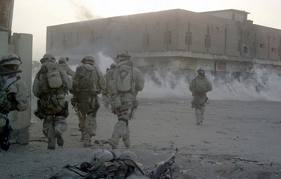
Marines maneuver in Umm Qasr during a hot phase of the Iraq War for U.S. forces. /U.S. Department of Defense photo

The Iraq War is far from over.

In yet another journalism tour de force, Frontline has laid bare the folly of two American presidents in Iraq. From George W. Bush's bumbling occupation of the country to Barack Obama's ill-fated rush to find an exit, successive U.S. administrations have been poking a hornet nest in the heart of the Middle East.

The Iraq War smeared Bush's legacy. As Iraq's bubbling cauldron of sectarian animosity between Shiites, Sunnis and Kurds threatens to explode, Obama's standing in the eyes of history now weighs in the balance.

If Obama is not pondering renewed intervention in Iraq, he should be.

With the Islamic State of Iraq and the Levant (ISIS) threatening to overrun the central government in Baghdad, al-Qaeda and other groups openly hostile to the United States and its allies in the region are flourishing in the Fertile Crescent country.

The current occupant of the White House faces a challenge dripping with irony: Obama inherited the Iraq War from his predecessor, and he has wanted to disengage from Day 1 of his administration. Now, he faces the prospect of launching his own war in Iraq.

The clock is ticking.

If Obama intervenes to rescue Iraq from chaos, he would likely doom many Democrats running for Congress in November. The Iraqi state could meet its doom any day.

Monday, July 14, 2014

Pain pills an excruciating necessity

Hillsides at the Aquinnah Cliffs on Martha's Vineyard start to turn green in May 2014. Death stalks us even at the most beautiful places on Earth. /Christopher Cheney photo

Opinions are almost never news; but when they are, the stakes are almost always astronomical.

For nearly two decades, I steadfastly avoided writing opinion columns, fearing it would loosen my desperate grasp on objective reporting. The possibility of crafting a weekly health plan column that would have any significant impact was not even the shred of a thought in my mind when I was covering the town of Franklin, Mass., as a cub reporter in the mid-1990s.

As I reach the six-month mark working at HealthLeaders Media, a weekly health plan column installment has become a surprising source of pride, albeit of the bittersweet variety.

A rarely shared secret of the journalism profession is the frequency of occasions when reporters are required to become nearly instant experts, with varying degrees of success. When I decided to write a health plan column about efforts to curb painkiller medication abuse, my opinions were supportable but insufficiently expert to capture the full truth.

One of my best friends, who worked with me in the Franklin Bureau back in the day, shared his expert opinions on painkiller medications and helped me shine light on one of the country's darkest medical quandries. The Mayor of Martha's Vineyard started forming those expert opinions the dark night death visited the seat next to him in the twisted wreckage of car on the island.

Read his truthful account about painkiller medication abuse in America.

Sunday, May 25, 2014

China playing rough in superpower game

The U.S. Department of Justice accuses five Chinese military officers of cyber espionage, including the theft of intellectual property such as product designs from American companies. /CNN image

Still have any doubts about the Chinese playing rough on the world stage?

The U.S. grand jury indictment of five Chinese military officers last week on economic espionage charges is the latest proof of Beijing's relentless quest for superpower status. While only a symbolic legal gesture, the 31-count indictment accuses the spying suspects of hacking into the computer systems of American companies to steal information "that would be useful to their competitors in China," a prepared statement from the U.S. Department of Justice says.

"For too long, the Chinese government has blatantly sought to use cyber espionage to obtain economic advantage for its state-owned industries," FBI Director James Comey said.

The U.S. attorney who prosecuted the Chinese People's Liberation Army officers before the Western Pennsylvania grand jury condemned Beijing's cyber snooping.

"This 21st century burglary has to stop," U.S. Attorney David Hickton said. "This prosecution vindicates hard working men and women in Western Pennsylvania and around the world who play by the rules and deserve a fair shot and a level playing field."

Wednesday, April 30, 2014

This cat was more than an 'animal' or 'pet'

Chop Chop was a great companion but an awful editorial assistant. /Family photo

I lost one of my best friends yesterday.

Anyone who thinks house cats lack personality, intelligence and complex emotions never met Chop Chop.

When I was working nights at the Portsmouth Herald, she would hear my car pull into the driveway at 1 a.m. and greet me at the door. She knew how to push my buttons when she was hungry and wanted more food in her bowl. She fought cancer for the past two years, but she was filled with love until the moment she took her last breath at the vet's office.

Humans are not the only sentient beings on this planet.