Sunday, August 17, 2014

Ferguson reminder about race in America

Police in riot gear confront protesters in Ferguson, Mo. The fatal police shooting of an unarmed African American teenager on Aug. 9 inflamed racial tensions in the St. Louis suburb. /Image via npr.org

Many Americans want racially charged issues to go away.

But the final steps in the country's 400-year-long journey through the pitfall-strewn landscape of racial injustice have yet to be taken.

Whether it fits into your view of the United States or not, the racially charged violence sparked by the police shooting of 18-year-old Michael Brown in Ferguson, Mo., is an ugly reminder about the country's struggle to overcome centuries of bias against African Americans.

As long as African American teenagers walking down the street are at high-risk of being shot to death, America has more steps to take.

As long as white men think it is acceptable to drive around in their pickups with battlefield Confederate flags flying from the truck bed, America has more steps to take.

As long as nearly half of the people incarcerated in the United States are black, America has more steps to take.

Saturday, August 2, 2014

Iraq War: Surge II decision looms after U.S. election

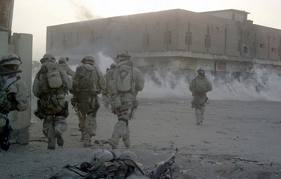
Marines maneuver in Umm Qasr during a hot phase of the Iraq War for U.S. forces. /U.S. Department of Defense photo

The Iraq War is far from over.

In yet another journalism tour de force, Frontline has laid bare the folly of two American presidents in Iraq. From George W. Bush's bumbling occupation of the country to Barack Obama's ill-fated rush to find an exit, successive U.S. administrations have been poking a hornet nest in the heart of the Middle East.

The Iraq War smeared Bush's legacy. As Iraq's bubbling cauldron of sectarian animosity between Shiites, Sunnis and Kurds threatens to explode, Obama's standing in the eyes of history now weighs in the balance.

If Obama is not pondering renewed intervention in Iraq, he should be.

With the Islamic State of Iraq and the Levant (ISIS) threatening to overrun the central government in Baghdad, al-Qaeda and other groups openly hostile to the United States and its allies in the region are flourishing in the Fertile Crescent country.

The current occupant of the White House faces a challenge dripping with irony: Obama inherited the Iraq War from his predecessor, and he has wanted to disengage from Day 1 of his administration. Now, he faces the prospect of launching his own war in Iraq.

The clock is ticking.

If Obama intervenes to rescue Iraq from chaos, he would likely doom many Democrats running for Congress in November. The Iraqi state could meet its doom any day.

Monday, July 14, 2014

Pain pills an excruciating necessity

Hillsides at the Aquinnah Cliffs on Martha's Vineyard start to turn green in May 2014. Death stalks us even at the most beautiful places on Earth. /Christopher Cheney photo

Opinions are almost never news; but when they are, the stakes are almost always astronomical.

For nearly two decades, I steadfastly avoided writing opinion columns, fearing it would loosen my desperate grasp on objective reporting. The possibility of crafting a weekly health plan column that would have any significant impact was not even the shred of a thought in my mind when I was covering the town of Franklin, Mass., as a cub reporter in the mid-1990s.

As I reach the six-month mark working at HealthLeaders Media, a weekly health plan column installment has become a surprising source of pride, albeit of the bittersweet variety.

A rarely shared secret of the journalism profession is the frequency of occasions when reporters are required to become nearly instant experts, with varying degrees of success. When I decided to write a health plan column about efforts to curb painkiller medication abuse, my opinions were supportable but insufficiently expert to capture the full truth.

One of my best friends, who worked with me in the Franklin Bureau back in the day, shared his expert opinions on painkiller medications and helped me shine light on one of the country's darkest medical quandries. The Mayor of Martha's Vineyard started forming those expert opinions the dark night death visited the seat next to him in the twisted wreckage of car on the island.

Read his truthful account about painkiller medication abuse in America.

Sunday, May 25, 2014

China playing rough in superpower game

The U.S. Department of Justice accuses five Chinese military officers of cyber espionage, including the theft of intellectual property such as product designs from American companies. /CNN image

Still have any doubts about the Chinese playing rough on the world stage?

The U.S. grand jury indictment of five Chinese military officers last week on economic espionage charges is the latest proof of Beijing's relentless quest for superpower status. While only a symbolic legal gesture, the 31-count indictment accuses the spying suspects of hacking into the computer systems of American companies to steal information "that would be useful to their competitors in China," a prepared statement from the U.S. Department of Justice says.

"For too long, the Chinese government has blatantly sought to use cyber espionage to obtain economic advantage for its state-owned industries," FBI Director James Comey said.

The U.S. attorney who prosecuted the Chinese People's Liberation Army officers before the Western Pennsylvania grand jury condemned Beijing's cyber snooping.

"This 21st century burglary has to stop," U.S. Attorney David Hickton said. "This prosecution vindicates hard working men and women in Western Pennsylvania and around the world who play by the rules and deserve a fair shot and a level playing field."

Wednesday, April 30, 2014

This cat was more than an 'animal' or 'pet'

Chop Chop was a great companion but an awful editorial assistant. /Family photo

I lost one of my best friends yesterday.

Anyone who thinks house cats lack personality, intelligence and complex emotions never met Chop Chop.

When I was working nights at the Portsmouth Herald, she would hear my car pull into the driveway at 1 a.m. and greet me at the door. She knew how to push my buttons when she was hungry and wanted more food in her bowl. She fought cancer for the past two years, but she was filled with love until the moment she took her last breath at the vet's office.

Humans are not the only sentient beings on this planet.


Monday, April 21, 2014

Arkansas on epic healthcare reform quest

Arkansas Gov. Mike Beebe signs the state's "private option" Medicaid expansion law in April 2013. /npr.org photo

I have been politically aware since Jimmy Carter was elected president and a member of the U.S. workforce nearly as long. Arkansas' level of cooperation and conciliation on healthcare reform seems unprecedented.

The Natural State is on the verge of creating the country's first public-private, universal payer, value-based healthcare delivery system. This pioneering effort could show the way forward for many other states.

In the most exciting project I have worked on so far at HealthLeaders Media, top Arkansas officials including Gov. Mike Beebe share their amazing healthcare reform journey in a three-part series of stories and accompanying health plan column:

Health Plan Column: An Unlikely State Schools Nation on Healthcare Payment Reform

Part I: Crisis Spurs Healthcare Payment Reform in Arkansas

Part II: Governor Details Healthcare Payment Reform Path in Arkansas

Part III: Payment Reform Paying Off in Arkansas, For Now

Sunday, April 13, 2014

Patient Protection and Affordable Care Act Truths

Millions of Americans are gaining access to healthcare for the first time not only in their lifetimes, but also in generations. The poorest Americans are most likely to be uninsured. One third of Americans who live in poverty are children. /Heifer 12X12 image by Betty Londergan

Practically and politically, all Americans need to make up their own minds about the federally driven healthcare reform efforts across the country.

Practically, the reforms are so far-reaching they will touch most of our families directly or indirectly. For the first time, the majority of Americans are being asked to become informed consumers of healthcare. If you pick the wrong healthcare coverage, it could cost you or a loved one thousands of dollars in deductibles and other cost sharing.

Politically, healthcare is this year's dominant issue. Republicans have cast the Patient Protection and Affordable Care Act as President Obama's Waterloo, with this fall's midterm elections billed as a referendum on the Obama administration's signature domestic policy initiative.

After spending the past three months deep in the weeds of U.S. healthcare reform efforts, I can report the following truths to help guide my fellow citizens for practical and political purposes:

  • Underperforming: The U.S. healthcare "system" is broken and needs fixing. America has the best doctors and medical technology in the world, but healthcare quality and accessibility varies greatly from state to state and community to community. And the current fee-for-service healthcare model promotes volume, not value. Fee-for-service promotes a twisted incentive for healthcare providers: the sicker the population, the higher the volume of patients, the higher the fees.
  • Desperate measures: Obama probably lied when he repeatedly said "you can keep your health plan if you like it." President Franklin Roosevelt definitely lied when he maneuvered the United States into World War II. Hitler had to be stopped, so Americans forgave FDR for fibbing. If Obama can fix U.S. healthcare, Americans will forgive him, too. 
  • Dialogue: The focus on healthcare reform from DC to every American's downtown is a good thing.
  • Blended approach: The PPACA is closer to a Republican road map than a socialist plot. The PPACA is a patchwork of market-based reforms and expansion of existing government programs. On the market side, new "exchanges" established by federal and state officials provide a marketplace for private insurers to offer health insurance policies to individuals and small businesses. The exchanges hold the promise of expanding healthcare access to millions of low- and moderate-income Americans. On the government side, Medicaid is the biggest program expansion. Half the states have embraced Medicaid expansion, with some crafting a "private option" through the new individual exchanges. Millions of poor Americans have already gained health insurance through Medicaid expansion efforts over the past year.
  • Common good: The primary goals of the PPACA are to expand access and lower costs while maintaining a high level of healthcare quality. Any alternative to the PPACA should be measured against these worthy aspirations.
In 2011, more than 1.1 million Michigan residents were uninsured, or nearly 12 percent of the the state's population. /The Daily Mirror image

Friday, January 17, 2014

Fox News: Right turn into irrelevancy

Bill O'Reilly serves up a favorite whipping-post story tailored to Fox News' conservative viewership. /Fox News image

A battle for the heart and soul of the Grand Old Party is about to rage in congressional districts across the country. Then in 2016, the Republicans will get a shot at an open seat in the White House.

There's a bitter irony ahead for FOX News chief Roger Ailes and other conservative Republican kingmakers. Fox News has been successful in energizing the far-right of American politics, but the candidates and policies generating the most passion in the Republican Party are now so extreme that winning a presidential election seems unlikely.

Wednesday, January 15, 2014

Benghazi, dead diplomats and scoring political points

The April 1983 U.S. Embassy bombing in Beirut, Lebanon, killed 63 people.

Politics can get ugly, but the partisan bluster over Benghazi is revolting.

U.S. embassies and consulates are among the most dangerous places on Earth ... easy and frequent targets for the enemies of America.

U.S. diplomatic missions have been flash points for assassination attempts and bombings for decades. The April 1983 bombing of the U.S. embassy in Beirut is among the deadliest attacks, with 63 killed including 17 Americans. The Beirut embassy bombing was followed in October 1983 by suicide bomber attacks on U.S. Marine and French paratrooper barracks in Beirut, with 241 U.S. troops killed.

For those keeping track of the political points, Ronald Reagan was president in 1983.

In Benghazi, four Americans were killed at the U.S. consulate on Sept. 11, 2012.

It's a tragedy whenever lives are lost.

It's a farce to play politics with casualties at U.S. diplomatic missions.

American troops suffered heavy losses during the 1968 Tet Offensive in Vietnam, including a deadly attack on the U.S. Embassy in Saigon. /Image via historyimages.blogspot.com

U.S. consulate building in Benghazi, Libya, September 2012. /Image via amnesty.org

Al-Qaida-linked Egyptian Islamic Jihad bombed the US. Embassy in Nairobi, Kenya, in August 1998. About 212 people were killed and more than 4,000 were wounded. /Image via www.newstimeafrica.com


Sunday, January 12, 2014

Racism New England-style: This is how we do it

The state of New Hampshire has meted out a slap on the wrist for a supervisory-level employee who walked around her office referring to Chocolate Babies as "Nigger Babies." After the supervisor was "investigated," she was promoted to a position of higher authority over more workers.

All three of the New England states where I have lived have a problem with race.

The economic disparity of American racism is on full display in Connecticut, my birthplace. The Constitution State has historically been the top per-capita income state in the country, with four of the nation's poorest cities, where the people of color live.

Boston has been dragged kicking and screaming into racial harmony, from Elijah "Pumpsie" Green to public school busing, to the ongoing slow pace of economic development in blighted minority neighborhoods.

There are some hardcore, KKK-like racists in New Hampshire. If you have lived here long enough, you have probably seen them. The classic sighting is two white guys in a pickup truck, with two big stars and bars flags flying from either side of the truck bed.

But most New Hampshire racists have prejudice based in ignorance. Just a sampling of quotes from working folk and professionals in my 3-plus years in the state prove the point:

  • "Yeah, some of the worst niggers I know are white." -white male, construction worker, commenting on lack of racial diversity in New Hampshire
  • "I don't know what you are, but you sure are beautiful." -white male, doctor, trying to put move on woman of color
  • "When we were little, do you know what we called these? Nigger babies." -white woman, state of New Hampshire supervisory-level employee, commenting in the workplace to several colleagues about Chocolate Baby candies
Earl Wilson, left, the first black Red Sox pitcher, and Elijah "Pumpsie" Green, the first black Red Sox fielder, hang out in the dugout on Aug. 30, 1959. A decade earlier, the Red Sox held tryouts for Jackie Robinson and Willie Mays, declining to sign both Hall of Famers. /Leslie Jones photo via Boston Public Library